Casino game mechanics are the rules and systems that decide how a game produces outcomes and calculates payouts. These mechanics can include probability, game rules, RTP, house edge, paylines, card rules, bonus features and random number generators.
They do not tell us exactly what will happen on the next spin, card or round. Instead, they determine the mathematical structure within which individual results occur.
Game mechanics are simply the rules that make a casino game work.
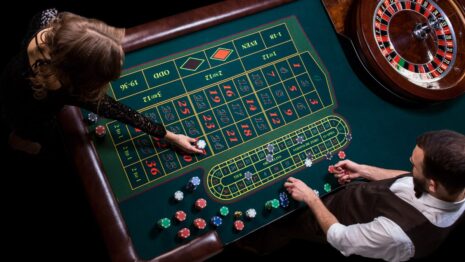
For example, roulette has rules about how many numbers are on the wheel and how much different bets pay. Blackjack has rules about dealing cards, hitting, standing and comparing the player’s hand with the dealer’s hand.
A slot machine has its own mechanics, including reels, symbols, winning combinations and bonus features.
Changing these rules can change the mathematical results of the game.
Probability is a major part of casino game mechanics.
It describes how likely different outcomes are.
For example, a standard European roulette wheel has 37 pockets: numbers 1 through 36 plus one zero. A straight-up bet on a particular number therefore has a probability of 1 in 37 of winning.
The payout for that bet is fixed by the game’s rules. Because the number of possible outcomes and the payout do not perfectly match the player’s probability of winning, the casino has a mathematical advantage.
Return to Player (RTP) is another important mechanic, particularly for slots and other games where a theoretical RTP is published.
A game with a theoretical RTP of 96% is designed to return an average of 96% of the money wagered over a very large number of plays.
This does not mean every player will receive 96% of their money back. Short-term results can be very different from the long-term mathematical expectation.
The UK Gambling Commission explains that actual RTP can fluctuate around theoretical RTP, particularly when the number of games or amount of play is relatively small. (gamblingcommission.gov.uk)
The house edge is the casino’s theoretical mathematical advantage.
For example, a game with a 4% house edge has a theoretical RTP of approximately 96%.
A higher house edge means that, over a very large number of wagers, the mathematical advantage for the casino is greater.
However, house edge does not predict the outcome of one particular game round. A player can win or lose regardless of the game’s long-term mathematical advantage.
Two games can have similar RTP values but produce very different patterns of results.
This is where volatility becomes important.
A low-volatility game may produce smaller wins more often, while a high-volatility game may produce larger wins less frequently. The UK Gambling Commission describes volatility in terms of the distribution of prizes and notes that it can be represented statistically using measures such as standard deviation. (gamblingcommission.gov.uk)
Therefore, RTP alone does not tell you how often wins will occur.
Modern casino games often include features such as:
These features are part of the game’s mathematics.
For example, a multiplier can increase the payout of a qualifying win, while a bonus round can introduce additional possible outcomes. The game developer accounts for these features when designing the overall mathematical model.
Even when the rules and mathematics are fixed, individual results remain uncertain.
Digital casino games commonly use random number generators (RNGs) to determine outcomes. Regulatory standards require random outcomes to meet specified statistical requirements. (gamblingcommission.gov.uk)
This means knowing a game’s mechanics does not allow someone to know exactly what the next result will be.
Game mechanics affect results by determining what outcomes are possible, how likely they are and how much each outcome pays.
RTP influences the long-term theoretical return, house edge describes the casino’s mathematical advantage, volatility affects the pattern of wins, and individual game rules determine how each round operates. Understanding these mechanics helps explain why casino results can vary from one play to another while still following a clearly defined mathematical system