The house edge is one of the clearest statistics for comparing the mathematical structure of casino games. It represents the casino’s theoretical advantage over a large number of wagers. A lower house edge means a smaller mathematical advantage for the casino, while a higher figure indicates a greater advantage.
The exact house edge can change depending on the rules, bet type and player decisions, so published statistics should always be viewed in context.
What Does House Edge Mean?
House edge is generally expressed as a percentage of the amount wagered.
For example, a 2% house edge means that the game’s mathematical model has an expected casino advantage of about $2 for every $100 wagered over a sufficiently large number of bets.
It does not mean that the casino wins exactly $2 from every $100 wager. Individual results can vary considerably because of randomness.
House edge and RTP are closely related:
House Edge = 100% − RTP
So a game with a theoretical RTP of 97.3% has a corresponding house edge of 2.7%.
Roulette Statistics
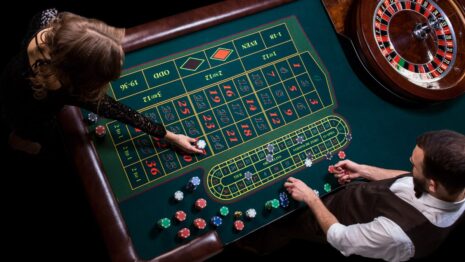
Roulette provides a particularly clear example of how rules affect house edge.
According to Wizard of Odds, single-zero European roulette has a house edge of about 2.70%, while double-zero American roulette has a house edge of 5.26% for standard even-money bets. (Wizard Of Odds)
The difference comes from the wheel layout. American roulette contains both 0 and 00, giving the casino a larger mathematical advantage.
This means that two games that look almost identical can have significantly different mathematical characteristics.
Baccarat Statistics
Baccarat also provides different house-edge figures depending on the wager.
For standard baccarat, Wizard of Odds lists approximately:
| Baccarat Bet | House Edge |
| Banker | 1.06% |
| Player | 1.24% |
| Tie | 14.36% |
The Tie bet has a substantially higher mathematical disadvantage than the Banker or Player bets. This illustrates why looking only at the name of a casino game is not enough; individual bets within the same game can have very different mathematics.
Blackjack Statistics
Blackjack is more complicated because the house edge depends heavily on the specific rules and how the player makes decisions.
Wizard of Odds lists examples where blackjack played with an appropriate basic strategy can have a house edge below 1%, although the exact figure depends on the rules in use. (Wizard Of Odds)
Factors such as the number of decks, blackjack payout, dealer rules and doubling or splitting rules can all influence the mathematical outcome.
Therefore, there is no single house-edge percentage that applies to every blackjack table.
Slots and Other Games
Slot-machine house edges can vary considerably because each game has its own mathematical configuration.
Wizard of Odds gives a broad range of approximately 2% to 15% for slot machines, illustrating how different slot designs can have substantially different theoretical returns. (Wizard Of Odds)
Other casino games can also have wide ranges. For example, the same source lists Keno at approximately 25%–29%, depending on the game, while some video-poker configurations can have house edges below 1%. (Wizard Of Odds)
Why Statistics Can Be Misleading Without Context
A house-edge figure is meaningful only when the specific rules and wager are known.
For example, saying that “baccarat has a 1.06% house edge” would be incomplete because that figure refers specifically to the standard Banker bet. The Tie bet has a dramatically different mathematical disadvantage.
Similarly, quoting a blackjack house edge without mentioning the rules and strategy can create an inaccurate comparison.
Comparing Popular Games
Some commonly cited figures can be summarized as follows:
| Game or Bet | Approx. House Edge |
| Baccarat Banker | 1.06% |
| Baccarat Player | 1.24% |
| European Roulette | 2.70% |
| American Roulette | 5.26% |
| Blackjack | Varies by rules and strategy |
| Slots | Varies considerably |
These figures are theoretical mathematical measures, not predictions of individual results.
Understanding the Numbers
House-edge statistics provide a useful way to examine the mathematical differences between casino games. They show how rules, payout structures and betting options can change the casino’s theoretical advantage.
The most important point is that a house-edge percentage should always be attached to a specific game version, bet and set of rules. That context turns a simple percentage into meaningful information about the mechanics of the game.